Multi-Agent Memory Sharing
Course Project | Stanford CS224N | Jan 2026 – Mar 2026
Can LLMs build a shared memory that actually improves over time without gradient updates or retraining? We designed a multi-agent pipeline to find out.
Context
LLMs often show reasoning gains during inference that do not persist across examples. Prior work (Suzgun et al., 2025) explored single-trajectory rewriting to address this. We extended that idea into a structured multi-agent system where agents collaboratively build and curate a shared external memory bank during evaluation.
Architecture
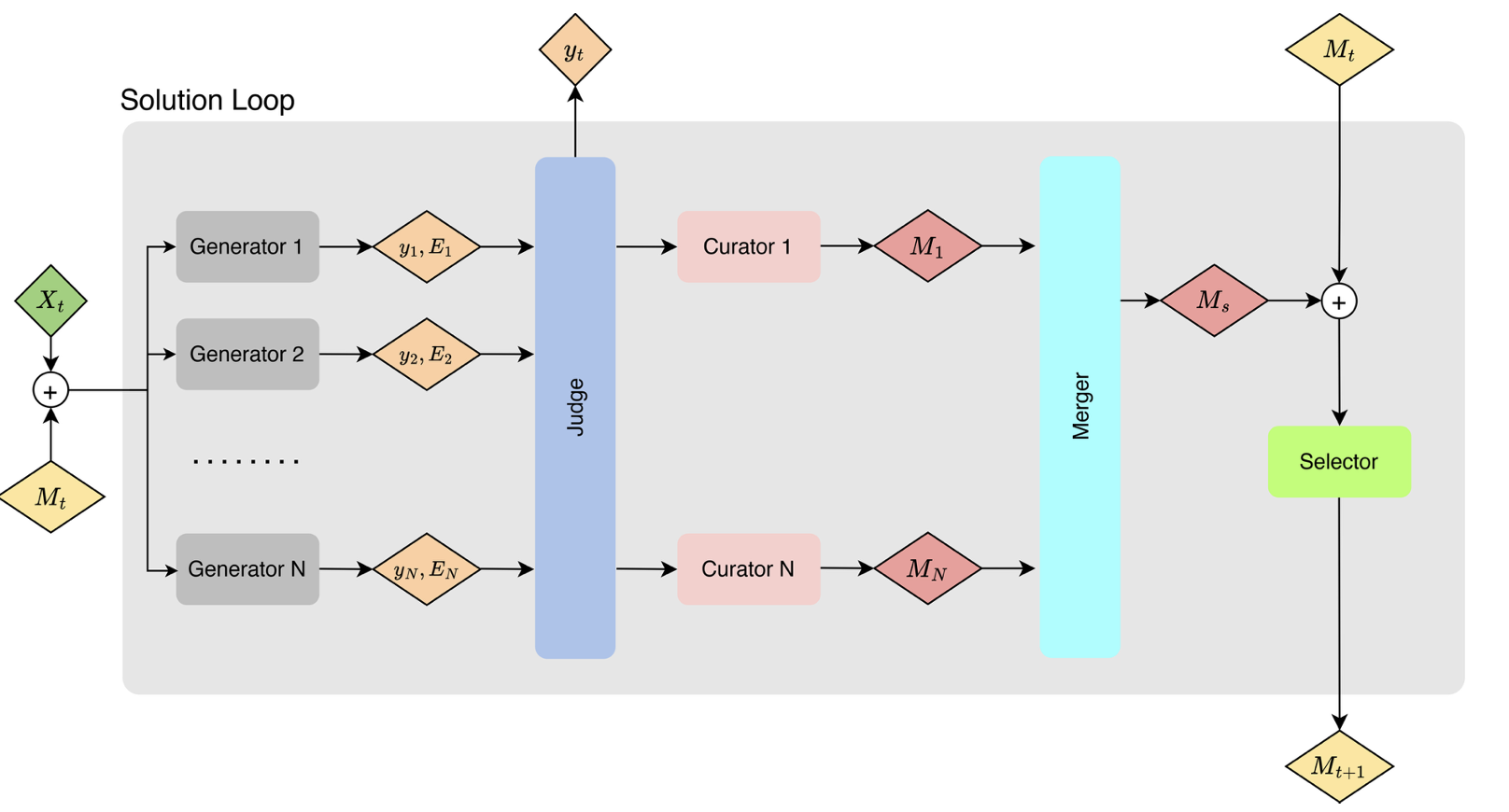
We designed a five-stage pipeline with explicit agent roles:
Generator
N agents independently solve problems using the current shared memory.
Judge
Filters valid answers and selects a representative one.
Converter
Distills explanations into reusable memory fragments.
Curator
Merges and deduplicates new fragments.
Selector
Prunes the memory bank to retain only the most useful entries.
Findings
Memory quality mattered more than size. Accuracy did not correlate with memory growth, and active pruning by the Selector was essential.
Multi-agent approaches consistently outperformed single-agent baselines on AIME 2024 (Math) and Game of 24 (Arithmetic). Results were preliminary and exploratory, with limited experimental scale.
Task fit mattered: AIME benefited from conceptual memory (for example, mathematical theorems), while Game of 24 memory was too instance-specific to generalize.