GNN Weather Forecasting
Bachelor's Thesis | Karlsruhe Institute of Technology | Jan 2025 – Jul 2025
Extended an existing Graph Neural Network approach for probabilistic weather forecasting, comparing 5 graph construction methods across different distance metrics on a 122-station European dataset.
Context
This was a bachelor's thesis extending Feik et al. (2024). I implemented their GNN pipeline from scratch, then built 4 additional graph types using altitude, altitude-orography discrepancy, and empirically-derived temperature similarity metrics as alternatives to geodesic distance.
What I Did
Implementation
Reproduced and extended a PyTorch Geometric GNN pipeline for probabilistic temperature forecasting.
Graph design
Built 5 graph variants using different distance metrics to connect weather stations: geodesic, altitude, altitude-orography discrepancy, and two empirical similarity metrics.
Evaluation
Benchmarked all graphs using CRPS (Continuous Ranked Probability Score), station-level CRPS, and calibration metrics across 3 lead times (24h, 72h, 120h).
Explainability
Applied permutation importance and GNNExplainer to understand which features and neighboring stations drive predictions.
Findings
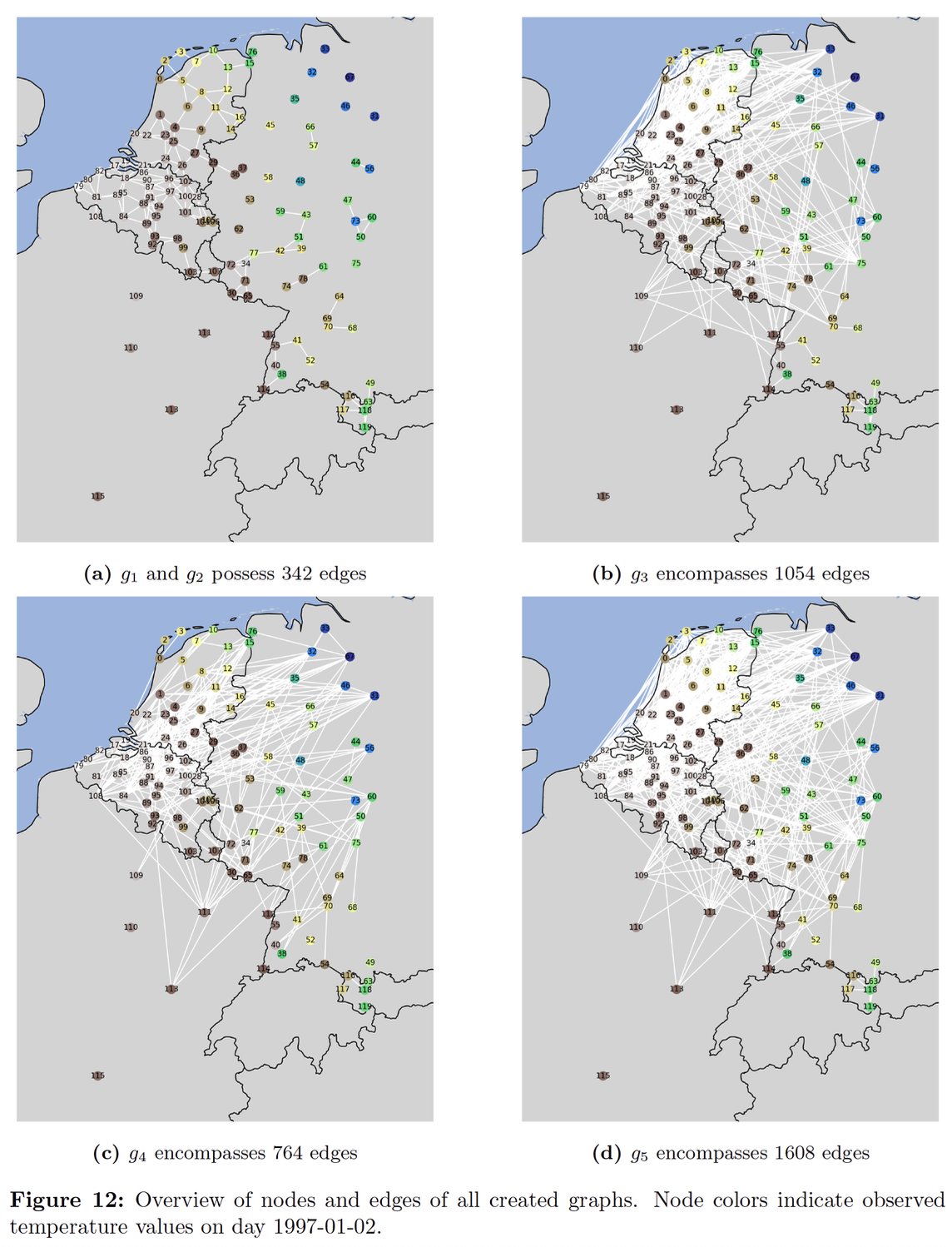
Geodesic distance (geographic proximity) consistently helped. The one graph without it performed worst. Adding more complex distance metrics did not clearly improve over the simple baseline. Temperature features dominated importance across all graph types, while explainability results varied by station geography.
GitHub: github.com/leachen01/gnnpp